Home › Container Size Guide
Container Size Guide
Which shipping container size is right for you?
Most buyers choose between three sizes, 10ft, 20ft and 40ft, plus a taller high cube option. This guide shows what each one actually holds, how much room you need to receive it, and how to match a size to your project, so you don’t pay for space you won’t use or run out of room.
Start here
The one thing that changes between sizes
It is simpler than it looks. Every standard container shares the same width and height, so choosing a size is really about length and floor space.
10ft, 20ft and 40ft are all 8′ wide and 8′6″ tall
The number is the external length. A 40ft is simply twice as long as a 20ft, with the same footprint width, the same door and the same height. So the real questions are: how much floor length do you need, and do you have room to place and receive it?
At a glance
10ft vs 20ft vs 40ft, side by side
The numbers buyers actually ask about: usable space, what fits, weight, and how much room you need to receive each one.
| Spec | 10 ft | 20 ft Most popular | 40 ft |
|---|---|---|---|
| External (L × W × H) | 10′ × 8′ × 8′6″ | 20′ × 8′ × 8′6″ | 40′ × 8′ × 8′6″ |
| Usable inside (L × W × H) | ~9′4″ × 7′8″ × 7′10″ | ~19′4″ × 7′8″ × 7′10″ | ~39′5″ × 7′8″ × 7′10″ |
| Door opening (W × H) | ~7′8″ × 7′5″ | ~7′8″ × 7′5″ | ~7′8″ × 7′5″ |
| Floor area | ~72 sq ft | ~146 sq ft | ~305 sq ft |
| Storage capacity | ~560 cu ft | ~1,170 cu ft | ~2,390 cu ft |
| Empty (tare) weight | ~2,800 lb | ~5,000 lb | ~8,200 lb |
| Max payload (approx.) | ~20,000 lb | ~47,000 lb | ~59,000 lb |
| Holds (household) | 1 to 2 rooms | 2 to 3 bed home | 4 to 5 bed home |
| Standard pallets (1 layer) | ~3 | ~9 to 10 | ~20 to 21 |
| Delivery run needed | ~50 ft | ~60 ft | ~100 ft or more |
| Best for | Tight spaces and small storage | The do-it-all default | Big loads and best value per cu ft |
Figures are typical and rounded for easy comparison. Exact dimensions and weights vary by manufacturer, age and condition (new, one-trip or used), and high cube units add 12″ of height. Your matched supplier confirms exact specs for any unit you are considering.
Find your size in 30 seconds
Answer two quick questions (a third if you like) and we will point you to the right size and the next step.
Pick an answer for questions 1 and 2.
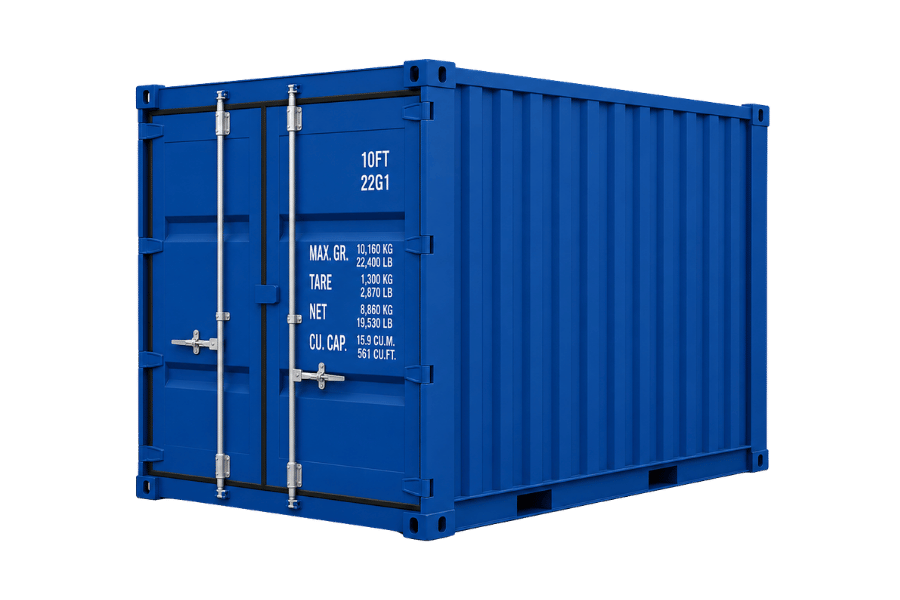
10 ft container
The small-footprint option
About the size of a large garden shed, the 10ft slots into spots a 20ft cannot reach, like a tight side yard or a small job site. One thing to know: 10ft units are less common and are often purpose-built or cut down from larger boxes, so availability is thinner and the price per square foot can run higher than a 20ft.
Key specs
- Floor area~72 sq ft
- Capacity~560 cu ft
- Inside length~9′4″
- Door opening~7′8″ × 7′5″
- Empty weight~2,800 lb
- Holds1 to 2 rooms
Great for
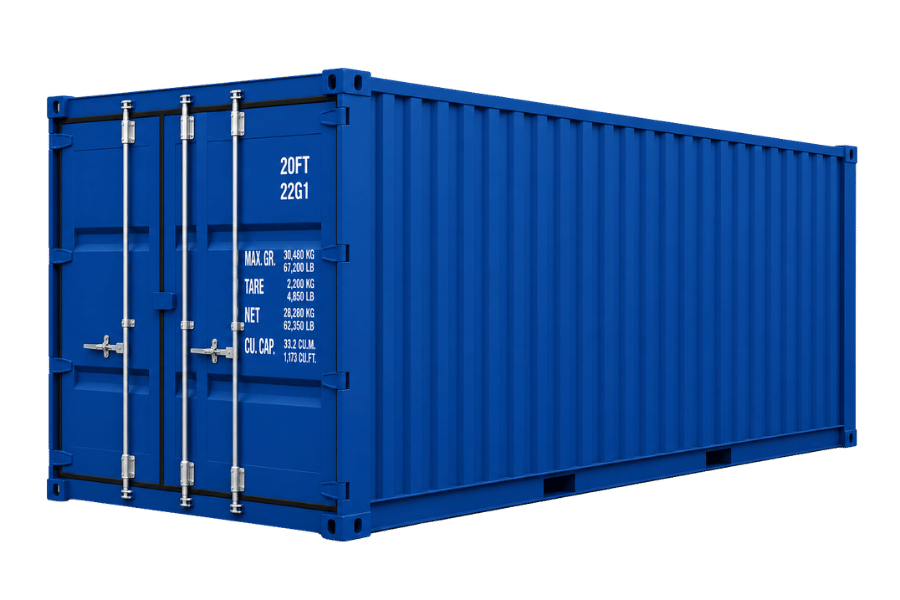
20 ft container
The versatile all-rounder
If you are not sure, this is usually the answer. The 20ft is the most requested size because it balances real capacity with a fair price and easy delivery, and its floor is roughly a single-car garage. It is big enough for most home moves and small-business stock, but still light and short enough to drop on most driveways.
Key specs
- Floor area~146 sq ft
- Capacity~1,170 cu ft
- Inside length~19′4″
- Door opening~7′8″ × 7′5″
- Empty weight~5,000 lb
- Holds2 to 3 bed home, ~9 to 10 pallets
Great for
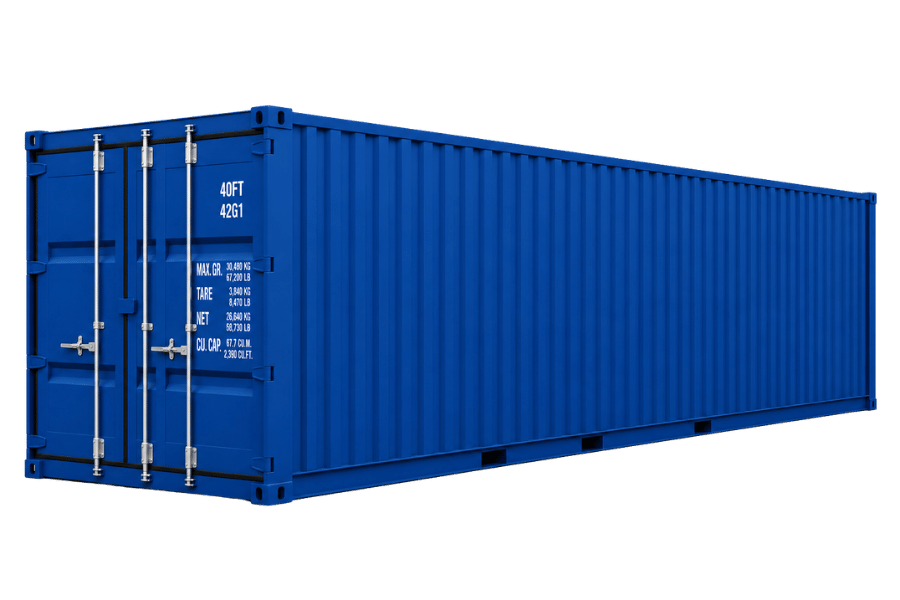
40 ft container
Double the length, best value per cubic foot
Same 8′ × 8′6″ footprint as a 20ft, just twice as long, so it holds roughly double and it is typically the lowest cost per cubic foot you can buy. It is the go-to for big moves, bulk storage and large conversions. If you need to walk around tall equipment or want comfortable headroom for a build-out, ask about the 40ft high cube, which is a foot taller.
Key specs
- Floor area~305 sq ft
- Capacity~2,390 cu ft (HC ~2,690)
- Inside length~39′5″
- Door opening~7′8″ × 7′5″
- Empty weight~8,200 lb
- Holds4 to 5 bed home, ~20 to 21 pallets
Great for
Height options
Standard or high cube?
There is a second height option worth knowing about. A high cube is the same length and width as a standard container but a full 12″ taller, 9′6″ on the outside and about 8′10″ of usable height inside. That extra foot adds roughly 13% more volume for the same footprint.
Choose a high cube when you need to stack taller pallets or machinery, want comfortable headroom for an office or living conversion, or just want more cubic space without taking up more ground. High cubes are most common in 40ft, and 20ft high cubes exist but are rarer. Build, doors and condition work the same way, so see container types for new versus used.
Before you buy
The size you can receive, not just the size you want
This is the step most size guides skip, and the one that trips people up. Most containers arrive on a tilt-bed or roll-off truck that slides the box straight off the back, so you need a clear, firm, level run for it to land.
- Straight-line run. About 60 ft for a 20ft and 100 ft or more for a 40ft. The truck cannot curve while it unloads.
- Firm, level ground. Gravel or concrete is ideal. Soft soil or a steep slope can stop a delivery.
- Overhead clearance ~14 ft. The bed tilts up high, so watch for power lines, low branches and eaves.
- Gate and turning room. A wide enough entrance and space to maneuver matters as much as the spot itself.
- Door swing. Leave about 6 ft of clearance at the door end so the cargo doors can open fully.
- Tight site? Ask about a crane placement, or splitting into two 20ft containers. Each adds cost.
Found your size? Get matched.
Tell us the size and your ZIP, and we will connect you with verified suppliers near you, free and with no obligation.
Compare free quotes