40ft Shipping Container Suppliers
Compare New and Used 40ft Shipping Containers & Conex Boxes
- Standard & high cube
- New & used condition grades
- No-obligation quotes
A 40ft shipping container gives you about 300 sq ft of lockable, weatherproof floor space in either standard (8′6″) or high cube (9′6″) height. ContainerMondo matches you with verified 40ft container suppliers near you, so you can compare condition grades, delivery access, and local pricing before you buy. Also known as a 40ft conex box, cargo container, or storage container.
Compare 40ft Container Prices and Save!
It takes less than 60 seconds to fill out the form and get matched with up to 5 verified suppliers near you.
Dimensions & specs
40ft container specs, side by side
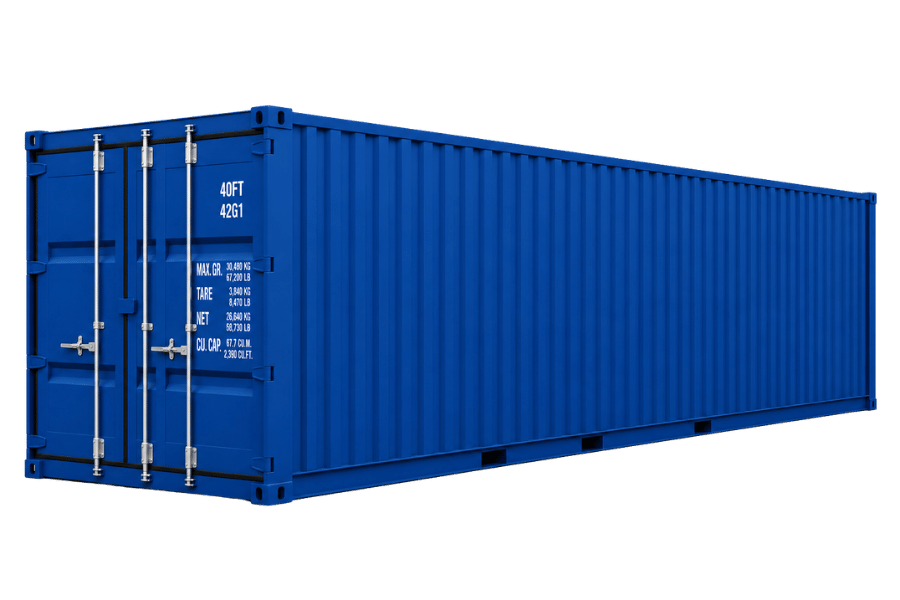
The two 40ft options buyers actually choose between: standard and high cube. The only real difference is one foot of height, but it changes volume, headroom, and price.
40ft Standard
8′6″ tall| External (L×W×H) | 40′ × 8′ × 8′6″ |
| Internal length | 39′ 5″ |
| Internal width | 7′ 8″ |
| Internal height | 7′ 10″ |
| Door opening (W×H) | 7′8″ × 7′6″ |
| Floor area | ~300 sq ft |
| Internal volume | ~2,390 cu ft |
| Tare (empty) weight | ~8,200 lb |
| Max payload | ~59,000 lb |
40ft High Cube
9′6″ tall| External (L×W×H) | 40′ × 8′ × 9′6″ |
| Internal length | 39′ 5″ |
| Internal width | 7′ 8″ |
| Internal height | 8′ 10″ |
| Door opening (W×H) | 7′8″ × 8′5″ |
| Floor area | ~300 sq ft |
| Internal volume | ~2,700 cu ft |
| Tare (empty) weight | ~8,750 lb |
| Max payload | ~58,400 lb |
Figures are nominal ISO standards and vary slightly by manufacturer and age. Max payload is the container’s structural rating. Road-legal limits for hauling a loaded container are lower and depend on your state. For most buyers the container arrives empty, so payload mainly matters if you will load it heavily in place.
Standard vs high cube
That extra foot matters more than you’d think
A 40ft high cube is exactly one foot taller than a standard 40ft, 9′6″ instead of 8′6″ outside, giving about 8′10″ of interior headroom. That foot adds roughly 300 cubic feet and makes a real difference if you will stand, build, or stack inside.
- Choose high cube for homes, offices, or gyms, where you keep usable headroom after a floor and ceiling go in.
- Choose standard when cost is the priority and 7′10″ is plenty, which covers most storage and site use.
- In the new / one-trip market, high cube is often the default 40ft, and it can cost the same or less, since it is what suppliers stock most.
Condition grades
Know what you’re paying for
“Used” covers a wide range. These are the grades suppliers actually quote, so getting the right one means you won’t overpay or end up with a leaky box.
New / One-Trip
Made overseas and shipped once to reach the U.S., so it is essentially like-new: current paint, tight doors, minimal wear, valid CSC plate. The pick for conversions, branding, or anything where looks and longevity matter.
Highest priceCargo-Worthy (CW)
Certified structurally sound and still fit for international shipping. Expect surface rust and cosmetic dings, but it is watertight with working doors. The best all-rounder for storage and most jobs.
Mid priceWind & Watertight (WWT)
Keeps wind and water out but is not certified for shipping. More rust and dents, doors still seal. Great value for a container that is going to sit in one spot as storage.
Lower priceAs-Is
Sold exactly as it stands, so it may have a leak, floor damage, or a stiff door. Cheapest option, best for buyers who can do repairs or don’t need it watertight. Always inspect or ask for photos first.
CheapestWhat a 40ft is good for
Twice the floor of a 20ft
A 40ft gives roughly double the space of a 20ft for far less than double the price, making it the better deal per square foot if you have room for it.
Large-scale storage
Equipment, inventory, seasonal stock, or jobsite materials. One 40ft swallows what would take several sheds, lockable and weatherproof.
Homes & offices
The 40ft high cube is the conversion favorite. The length suits open layouts, and the extra headroom survives insulation and finishing.
Workshops & garages
Room for a full bench, tools, and a project with space to move. Power it, light it, and work year-round.
Agriculture & equipment
Secure storage for implements, feed, and supplies out on the land, where 40ft of dry, rodent-resistant steel earns its keep.
Retail & pop-ups
Bars, cafés, and market stalls. A 40ft gives footprint for a counter, prep, and a line without feeling cramped.
Cold storage
Need refrigeration? A 40ft reefer holds chilled or frozen goods. See refrigerated containers.
Delivery & placement
Make sure a 40ft can actually reach the spot
This trips up more first-time buyers than price does. A 40ft is long, and the most common delivery method needs a lot of straight room to offload.
- Tilt-bed (roll-off) delivery is standard: the truck tilts its bed and slides the container off the back while driving forward. Plan for roughly 100+ ft of straight, level clearance in line with the drop spot.
- Tight site? A flatbed plus a crane (HIAB), or a forklift you provide, can set it down precisely in a small space, but it costs more.
- Width & overhead: leave about 12 ft of width and clear any low branches or power lines along the approach.
- Prep the ground: firm and level. Set the corners on concrete blocks, piers, or railroad ties so it drains, stays square, and the floor is not sitting in water.
- Leave door room: the cargo doors swing wide at one end, so keep a few feet clear there.
- Check permits: some towns require one to place a container on residential property. A quick call to your local office saves headaches.
Not sure it will fit? Tell suppliers about your access when you request quotes. Good ones will flag a tight site and suggest crane delivery before the truck shows up.
Before you buy used
A 5-minute inspection that saves you later
If you can see the container in person or get photos, run through this. It is the difference between a solid box and a money pit.
- CSC plate: present and current if you need cargo-worthy or plan to ship.
- Floor: marine ply solid underfoot, no soft spots or rot. Ask what it last carried.
- Roof: look for dents that pond water and the pinhole leaks they cause.
- Seams & corners: surface rust is normal, flaking or perforating rust is not.
- Doors: open and shut both, check the rubber gaskets and that locking bars move freely.
- Daylight test: close the doors and look inside. Light coming through means it is not watertight.
What a 40ft costs
Ballpark pricing by condition
Container only, so delivery and any modifications are extra. Prices move with steel costs, the season, and how close you are to a port or depot, so treat these as a starting point.
| Condition | 40ft Standard | 40ft High Cube |
|---|---|---|
| As-is / wind & watertight | $1,500 to $2,800 | $1,700 to $3,000 |
| Cargo-worthy | $2,000 to $3,500 | $2,300 to $3,800 |
| New / one-trip | $3,500 to $5,500 | $3,800 to $6,000 |
Coastal and port-adjacent areas usually run cheaper, while inland and rural delivery adds cost. For real numbers where you are, run the cost estimator or get matched for free quotes.
40ft or 20ft?
When to size up, and when not to
A 40ft is the better value per square foot, but only if you can get it in and have somewhere to keep it. Here is the quick call:
- Go 40ft if you want maximum space, plan a conversion, and have the access plus a fairly permanent spot.
- Go 20ft if access is tight, you may need to move it, or the load is smaller. See 20ft containers.
- Two 20ft can beat one 40ft when you need storage in two places or easier maneuvering.
Quick comparison
20ft vs 40ft| 20ft floor space | ~150 sq ft |
| 40ft floor space | ~300 sq ft |
| 20ft internal volume | ~1,170 cu ft |
| 40ft internal volume | ~2,390 cu ft |
| Clearance to deliver | 40ft needs more |
| Easy to reposition | 20ft wins |
Ready to price a 40ft?
Get matched with verified 40ft container suppliers near you, free and with no obligation.
Get a free quote